From raw answers to a finished asset, in three passes.
- 01
The 26-Point Strategic Interview
You drop your core business parameters directly into our digital architecture. These structured prompts mirror the precise discovery sequence a multi-thousand-dollar boutique consulting firm uses to isolate your model’s unique strengths.
- 02
The Structural Translation Matrix
Our system reads your raw, unedited context variables. It runs your answers through a layered framework — using a built-in banned-language filter to block generic buzzwords, while sharpening your natural language into a powerful commercial directive.
- 03
The Unified Corporate Compass
Skip multi-week agency wait times and continuous feedback loops. Your complete strategic vision is compiled into a single, beautifully typeset master asset sent directly to your inbox in under an hour — tuned to guide your future copy, ads, and scaling decisions.
What do you do? Describe it in one or two sentences as if you’re telling a stranger at a coffee shop.
Plain language. The system sharpens it later — it never invents it.
What you wrote
“we help small businesses figure out their brand stuff so their marketing isn’t all over the place”
What the framework returns
A written foundation that gives independent operators one fixed reference — so every campaign, page, and hire starts from the same position instead of a fresh argument.
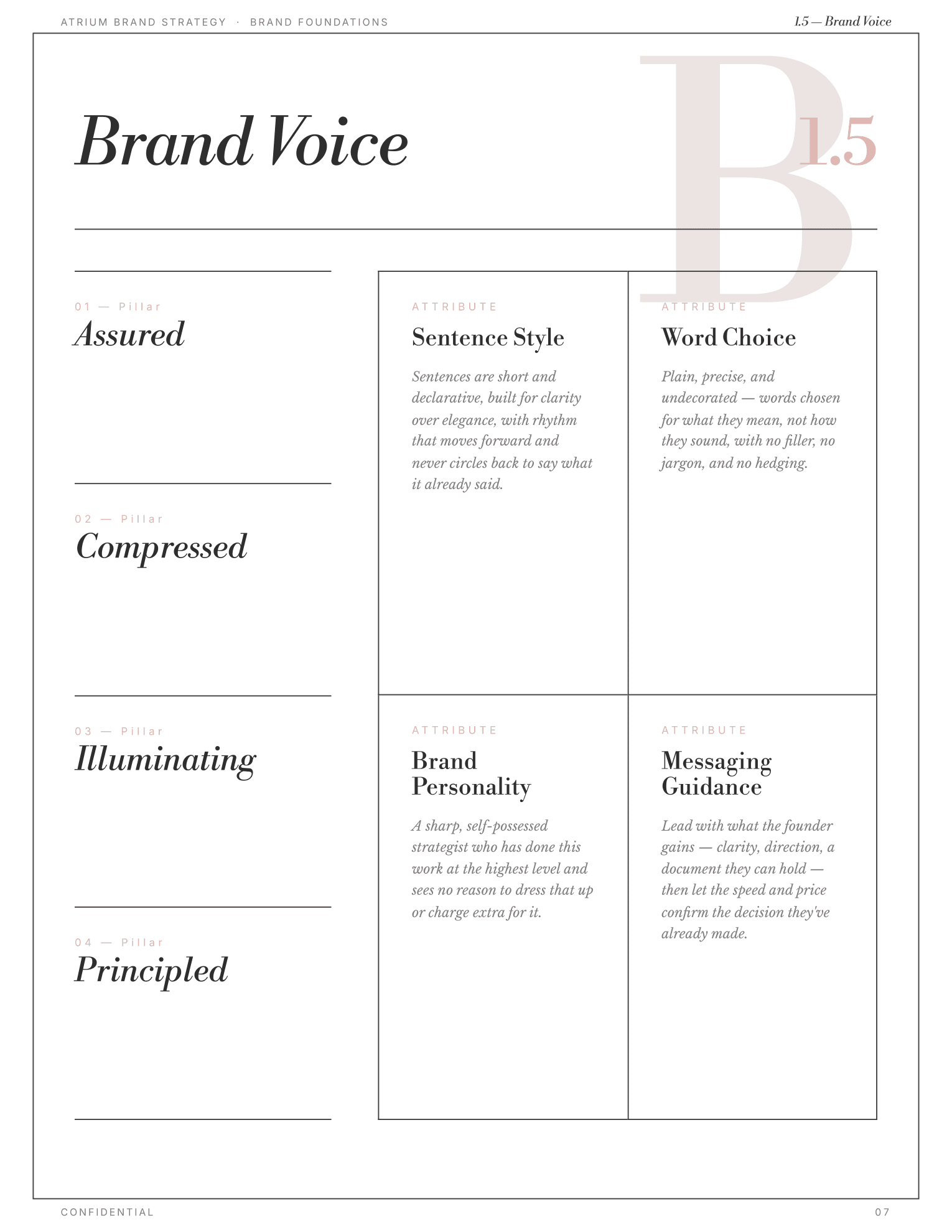
Section 1.5 — Brand Voice, from a real delivered document.
What the system is actually enforcing.
01Strategic Logic Alignment
Centralizes your core values, mission statement, and long-term execution targets into a single operational point of truth.
Ensures every piece of content, team document, or scaling decision you execute tracks against the goals you set.
02The Banned Language Filter
A prompt safety architecture that actively scans output variables to catch and remove industry filler.
Sanitizes generic phrase repetitions so your business sounds distinct from your direct competitors.
- Integrity
- Quality
- Excellence
- Trust
- Innovation
- Reliability
- Authenticity
- Transparency
- Passion
- Commitment
- Service
- Respect
- Honesty
- Teamwork
- Accountability
- Community
- Human
- Approachable
- Friendly
- Honest
- Reliable
- Professional
- Authentic
- Trustworthy
- Genuine
- Caring
- Helpful
- Knowledgeable
- Expert
03Brand Voice Protocols
Solidifies an unshakeable tonal blueprint that matches the unique identity of your business model.
Lets you onboard freelancers, copywriters, or internal staff without ever repeating yourself.
04Core Asset Anchoring
Treats any pre-existing logo vectors, color schemes, or active taglines as unbreakable brand anchors.
Integrates and refines what you have already invested in, building directly around your current business equity.
Stop letting your strategic vision live only in your head.
Deploy an unshakeable corporate compass for your company today. Complete processing from intake to inbox in under an hour.
Access the Diagnostic Engine — $197One time. Yours permanently. Guaranteed or refunded.